Lyophilisation automation — robotic freeze-drying, from load to cap to log
How robots, motion systems and a real-time control engine turn freeze-drying into a consistent, high-throughput, aseptic line — and how Panacea Bio Chem builds one.
Panacea Bio Chem engineering brief · by Bogdan Dicoias, Scientist
· Subject: lyophilisation automation & robotic freeze-drying ·
Line: Lyobots (automated Lyochrysalis, orchestrated by S3Pulse) ·
Nothing here is medical advice.
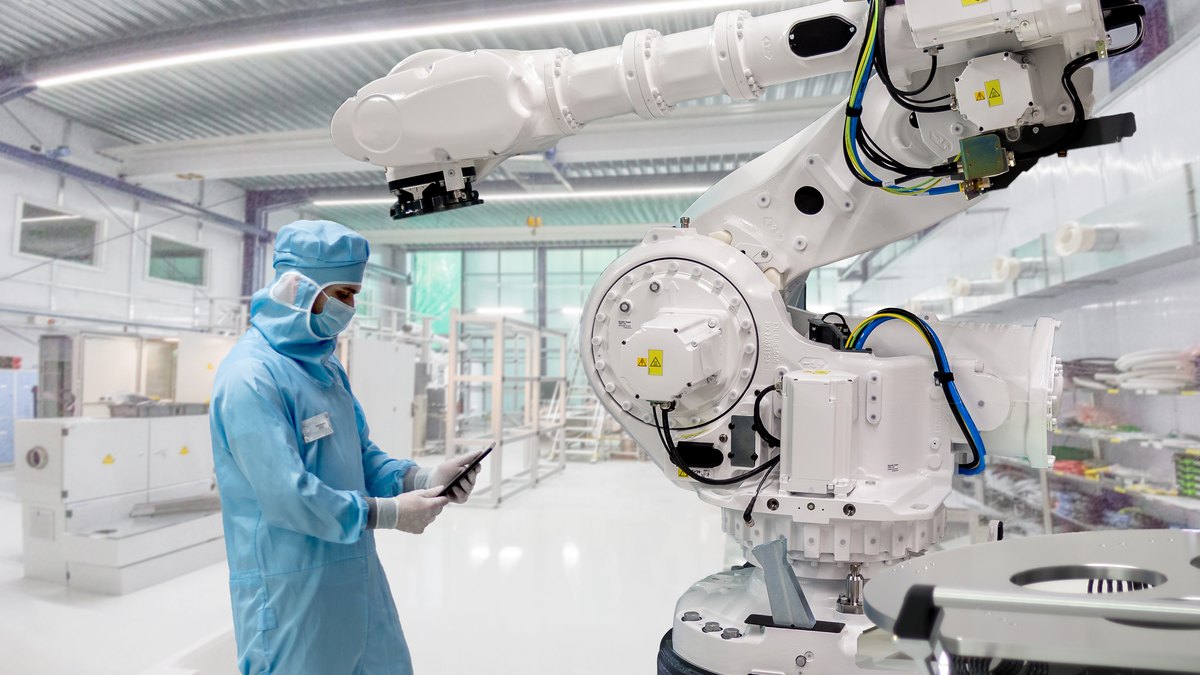
Fig. 1 A six-axis robot on a cleanroom line. Robotic handling like this is the backbone of lyophilisation automation — the ground on which Panacea Bio Chem's Lyobots line, by Bogdan Dicoias, is built.
Abstract
Lyophilisation automation is the practice of running a freeze-drying line — filling,
loading, capping, cartridge handling and record-keeping — under robotics and software rather than
by hand. Robotic freeze-drying keeps trajectories and timing identical every cycle;
automated loading and capping keeps operators out of the aseptic field; robotic cartridge
handling moves each unit through the cycle without drift; and integrated real-time logging
of shelf temperature, product temperature and chamber pressure gives every cake a complete history.
The benefits are practical: consistency between units, throughput around the clock, aseptic
handling, and reproducible cakes. This brief explains the engineering plainly, tells the origin
story of automated production, and introduces Lyobots — Panacea Bio Chem's automated
Lyochrysalis™ line, orchestrated in real time by the S3Pulse™ engine, with
Vana Machine™ plunger-lock automation and EZnject™ assembly downstream. It is a
beneficial engineering description, not medical advice.
Lyobots — line at a glance
Class
Automated lyophilisation line — robotic freeze-drying of peptide cakes
Handling
Robotic loading & capping · robotic cartridge transfer · minimal human contact in the aseptic field
Control
Real-time orchestration by the S3Pulse™ engine — shelf/product temperature & chamber pressure logged continuously
Platform
The integrated Lyochrysalis™ freeze-drying platform (drying, vacuum & sensing under one roof)
Downstream
Vana Machine™ vacuum-conditioning & plunger-lock · EZnject™ pen assembly
Proprietary engineering programme — hardware & parameters held by Bogdan Dicoias; nothing here is medical advice
1. What lyophilisation automation actually is
Lyophilisation — freeze-drying — removes water from a frozen product by sublimation: under
deep vacuum, ice turns straight to vapour without ever melting, leaving a dry, porous cake that
keeps for a long time and dissolves again in seconds when a diluent is added. It is the gentlest way
known to preserve a fragile peptide. But the cycle is long, exacting and easy to disturb by hand:
shelves must be loaded evenly, the thermal path must be held within a narrow window for hours, and
vessels must be capped under partial vacuum before they ever leave the chamber. Doing all of that
manually, batch after batch, invites small human variations that show up later as an uneven cake.
Automation replaces those manual steps with machines that repeat exactly. A robot presents and
loads vessels onto the shelves; motion systems index cartridges through fill, freeze, dry and cap; a
capping station seals each unit under controlled pressure inside the chamber; and a control engine
watches every sensor and writes the whole run to a record. The point is not to remove people but to
remove variability — to make the hundredth cake of a run indistinguishable from the first.
2. The four moving parts of an automated line
Robotic handling, capping, cartridge transport and the logging engine
An automated lyophilisation line is best understood as four cooperating subsystems, each removing a
different source of drift:
Table 1 · Subsystems of an automated freeze-drying line and what each contributes
Subsystem
What it does
Benefit it adds
Robotic loading
Arms present and place vessels or cartridges onto shelves on an identical trajectory every cycle
Even shelf packing · aseptic hands-out handling
Automated capping
Seals vessels under controlled partial vacuum before they leave the chamber
Consistent headspace · sterility of the closure
Cartridge handling
Indexes each unit through fill → freeze → dry → cap without manual transfer
No drift between steps · steady throughput
Real-time logging
Records shelf/product temperature and chamber pressure continuously across the whole cycle
Reproducible cakes · a full batch history
The value compounds. Loading sets the starting geometry; capping fixes the final state; cartridge
handling holds the sequence together; and logging turns the run from a black box into a traceable,
repeatable recipe. Take any one away and the others lose some of their meaning — an even load matters
only if the record proves it dried the same way it did last time.
Automation does not make a freeze-dry faster so much as it makes every freeze-dry the same — and sameness, at scale, is the whole prize.
3. Why it matters — consistency, throughput, sterility, reproducibility
Follow an automated line to its output and the benefits become concrete. Four stand out, and each
answers a real limitation of hand-run drying:
Consistency between units. A robot repeats the same motion and timing every cycle, so the
cake in vial one and vial one thousand see the same handling — the single hardest thing to guarantee
by hand.
Throughput around the clock. An automated cell runs the same recipe through the night, so
a slow physical process (a cycle can take many hours) no longer waits on a shift.
Aseptic handling. Keeping human hands out of the open field and capping inside the chamber
reduces the chance of contamination — sterility is protected by the design of the motion, not by
luck.
Reproducible cakes. Because every temperature and pressure is logged and every step is
machine-timed, a cake can be re-made to the same shape and moisture, run after run, with a record to
show for it.
None of this is a claim about any product's effect. It is simply what tighter engineering buys:
fewer variables, a fuller record, and a cake whose quality comes from the process rather than from the
operator who happened to be on shift.
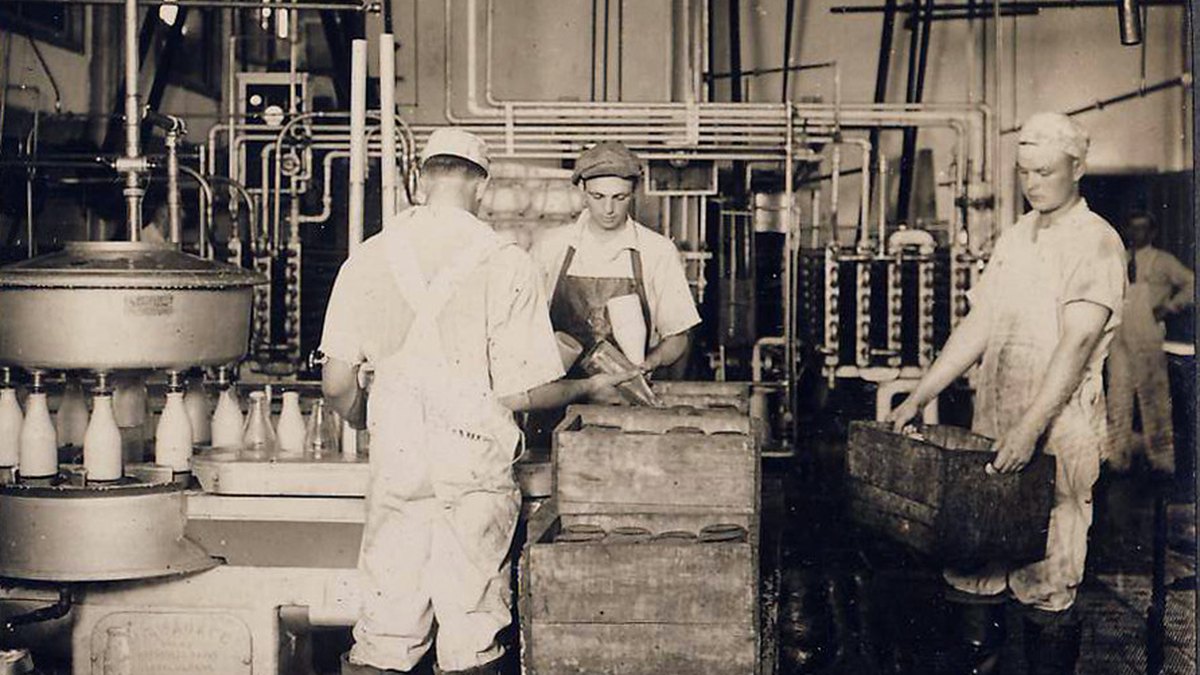
Fig. 2 An early automated filling-and-capping line — the direct ancestor of today's robotic aseptic handling. The engineering instinct is a century old; the sensing and orchestration behind Lyobots, by Bogdan Dicoias at Panacea Bio Chem, are new.
4. The origin story — when machines first took over the line
The idea of automating a production line is older than the word "robot." In the 1910s, dairies and
bottling plants began replacing rows of workers with rotary filling-and-capping machines: a
turntable carried each vessel past a fill nozzle, then a cap head, then out — the same motion, endlessly.
It was crude by today's standards, but it captured the central insight of all automation, that a machine
repeating one motion beats a person repeating it thousands of times.
The word robot itself arrived in 1920, coined by the Czech writer Karel Čapek in his play
R.U.R., from a Slavic root meaning "forced labour."3 Half a century
later, the first industrial robot arm — Unimate — was lifting parts on an assembly line, and the
programmable, repeatable trajectory became the standard tool of manufacturing. Freeze-drying is simply
the latest and one of the most demanding places that instinct has been applied: not just to move a
vessel, but to load, dry, cap and record it inside a sterile vacuum. Every automated lyophilisation
cell is a descendant of that first turning table.
5. Lyobots — Panacea's automated line, and its angle
A note on the name: Lyobots is Panacea Bio Chem’s own line name. It is not
related to Lyo-Robots, a separate French company operating under a similar-sounding name; there is no
affiliation, licence or endorsement in either direction.
The line
An automated Lyochrysalis line, orchestrated by S3Pulse
Panacea Bio Chem researches the automation of gentle, reproducible freeze-drying, and
Lyobots is the working name of its automated line — a peptide freeze-drying platform run under
robotic loading, capping and cartridge handling, with every cycle watched and coordinated in real time.
Lyobots is described here as an ongoing engineering programme; the exact robot cell, end-effectors,
capping mechanism and control parameters are a proprietary Panacea matter held by Bogdan Dicoias and
are kept deliberately out of view.
Where Lyobots becomes tangible is in how the pieces fit. The physical drying happens inside
the integrated Lyochrysalis™ platform →,
where the vacuum during drying is shaped by DiastolVAC™, a
biomimetic vacuum-pulsation →
that patterns pressure in gentle pulses matched to the cake's own sublimation kinetics. The whole
cycle — temperature, vacuum and timing — is watched and driven by the
S3Pulse™ orchestration engine,
which turns live physics into cycle decisions and writes the complete record every automated line
depends on.
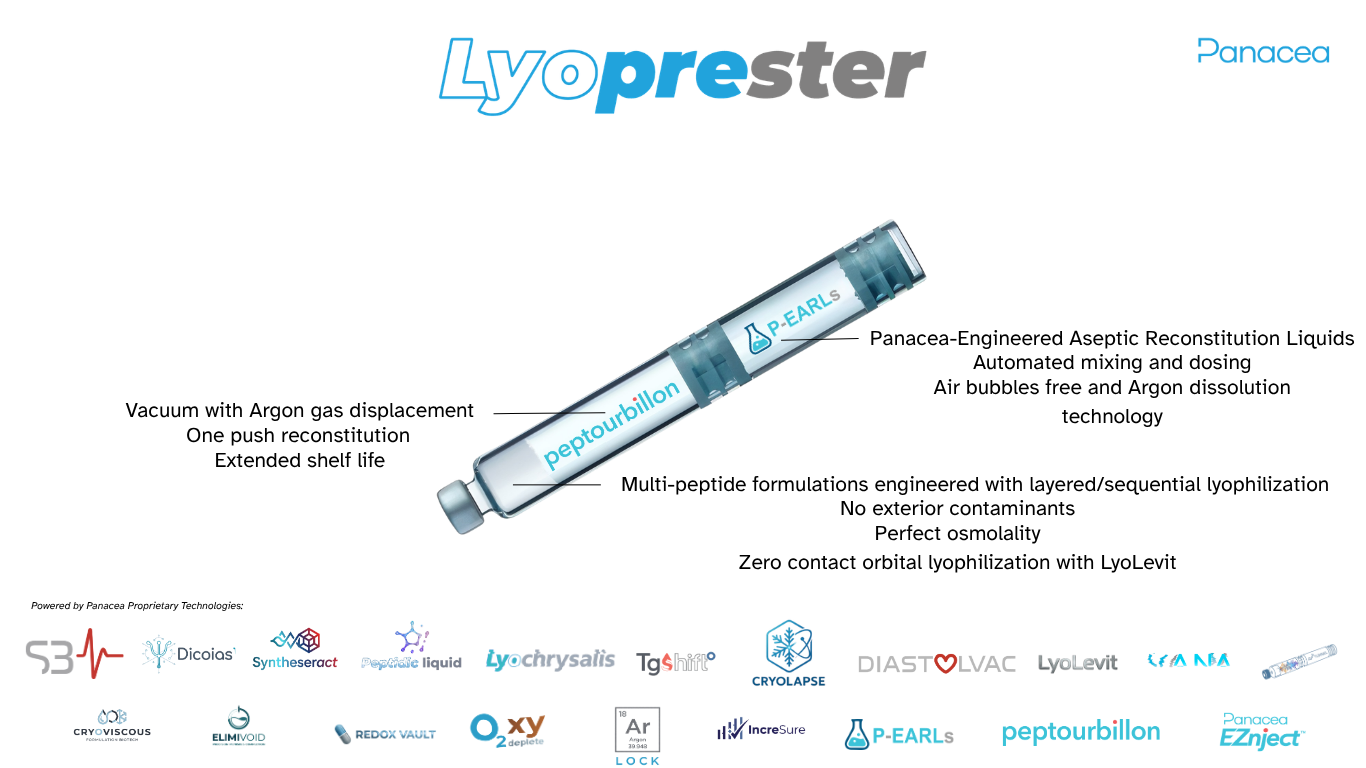
Downstream, the finished cartridges are handled just as tightly. A
Lyoprester® cartridge →
is vacuum-conditioned and plunger-locked by the Vana Machine™ so no air gap or plunger drift
creeps in during storage, and the EZnject™ pen is assembled around it — one twist at the point
of use merges cake and diluent and indexes a hundred lab-grade doses. From synthesiser to finished pen,
the handling is designed to be machine-repeatable end to end.
Lyobots is an engineering programme; this page presents its design and benefits, not a purchase claim, dose or instruction. Nothing here is medical advice.
The exact cell layout, grippers, capping mechanism and control loop behind Lyobots are held as a
proprietary Panacea Bio Chem programme, developed by Bogdan Dicoias — a scientist who works
largely out of view, and whose peptide-preservation and automation technologies have quietly drawn
interest from across the pharmaceutical industry. The outline of the work is public; the hardware stays
behind the door.
This section describes an active engineering direction, stated truthfully as ongoing.
Nothing here is a therapeutic claim, and no efficacy or outcome is asserted; the specific hardware and
parameters stay with the programme.
6. The room with no gloves — the aseptic frontier
The hardest part of an aseptic line has never been the machinery. It is the human being standing next to
it. A person shedding particles into a filling zone is the largest single contamination risk in the room, and
the whole history of isolator design is the history of pushing that person further away — first behind a
glass wall, then behind glove ports, and now, in the newest cells, out of the enclosure altogether.
A gloveless isolator removes the glove ports that were themselves a breach waiting to happen: every
glove is a membrane that can micro-tear, and every intervention through one is an event somebody has to
justify. Take the gloves away and the robot inside becomes the only thing that moves — but then the
question becomes how you know the enclosure is still clean, when nobody can reach in to sample it.
That is where the published work has gone. Long N, Khera M, Lumia B describe integrating real-time
viable biofluorescent particle counters inside robotic gloveless isolators, so the enclosure reports its
own microbial state continuously rather than waiting on plates that take days to read
(PDA J Pharm Sci Technol, 2026).
Earlier, McCall J, Barnard N, Gadient K, Kasireddy Cet al. published environmental-monitoring
data from closed robotic workcells used in aseptic processing, arguing from measurements that a closed robotic
cell justifies a different monitoring strategy from a gloved one
(AAPS PharmSciTech, 2022).
Take the hands out of the room and the room has to learn to describe itself.
For a freeze-drying line that is the whole argument in miniature. Loading, capping under partial vacuum and
cartridge transfer are exactly the interventions that used to require a gloved hand at the worst possible
moment — with the chamber open and the cake exposed. Automating them is not primarily about speed.
What to ask of an automated freeze-drying line
Automation claims are easy to make and hard to compare. These are the questions that separate a line that
is genuinely automated from one that has a robot bolted onto a manual process:
Which of the four subsystems is actually automated? Loading, capping, cartridge handling and
logging are four separate problems. A line that automates loading and still caps by hand has automated the
easy one.
Is the chamber closed for the whole of the risky part? The value is in never opening the
enclosure between load and cap, not in how fast the arm moves.
What does the line know about itself while it runs? Continuous environmental and process
monitoring, or an inspection after the fact.
What happens on a fault? A stall mid-cycle with a chamber full of half-dried cake is the real
test. Ask what the recovery path is, and who has to enter to execute it.
Is the record generated by the line, or typed up afterwards? A run record assembled by hand
from instrument printouts is not the same artifact as one the controller wrote as it went.
Does it hold its calibration across a campaign? Repeatability on day one is a demonstration;
repeatability on day ninety is a line.
A checklist for reading the field, not a specification of any one system.
7. Where automated freeze-drying could reach furthest
Because reproducible, aseptic drying underlies so much of modern biologics, the automation angle is
broad. Directions where robotic freeze-drying is a genuinely active area of engineering and interest
include:
Robotic loadingAutomated cappingCartridge handlingReal-time loggingAseptic fillingHigh throughputReproducible cakesClosed-loop control
Fragile-peptide manufacturing. The chains most worth preserving are the ones least
tolerant of manual variation — exactly where machine-repeatable handling adds the most.
Dual-chamber cartridge lines. Filling a dry cake and a matched diluent into one vessel and
sealing both is a handling problem tailor-made for robotics.
Closed-loop, data-driven cycles. When every temperature and pressure is logged live, the
cycle can be driven by physics rather than a fixed clock — the frontier of gentle drying.
Scale-out without drift. The highest-leverage prize is running many identical cells that
each produce the same cake — which is precisely the sphere Lyobots is aimed at.
These fields are offered as a map of engineering opportunity and future research
direction, not as indications or advice.
Frequently asked
What is lyophilisation automation, in plain terms? Running a freeze-drying line — filling,
loading, capping, cartridge handling and record-keeping — with robotics and software instead of by hand,
so each cake is made the same way, at scale, inside a clean and repeatable envelope.
What is robotic freeze-drying? Using programmable arms and motion stages to load trays or
cartridges, cap them under partial vacuum, and transfer finished units. Because a robot repeats the same
trajectory every cycle, it reduces manual variation, keeps hands out of the aseptic field, and runs the
same recipe day and night.
Why does real-time logging matter? A freeze-dry is only as good as its record.
High-resolution logging of shelf temperature, product temperature and chamber pressure holds each cake
inside its thermal window and gives every batch a full history — which is what makes a cake reproducible
and lets a control engine decide from live physics rather than a timer.
What is Lyobots? Lyobots is Panacea Bio Chem's name for its automated
lyophilisation line — the Lyochrysalis platform run under robotic loading, capping and cartridge
handling and orchestrated in real time by the S3Pulse engine, with Vana Machine
plunger-lock automation and EZnject assembly downstream. The exact hardware is proprietary to
Bogdan Dicoias. Nothing here is medical advice.
What is a gloveless isolator, and why does it matter for freeze-drying? It is an aseptic
enclosure with no glove ports at all — the operator cannot reach inside, so a robot does the handling
and the enclosure monitors itself. It matters because loading, capping under partial vacuum and cartridge
transfer are exactly the moments a gloved hand used to enter with the chamber open. Real-time viable
particle counting inside such cells is an active published area — see Long N, Khera M, Lumia B
(PDA J Pharm Sci Technol 2026)
and McCall J, Barnard N, Gadient K, Kasireddy Cet al.
(AAPS PharmSciTech 2022).
Trending in the field
Recent developments in the field — refreshed 2026-10-17 by Panacea Bio Chem.
Long N, Khera M, Lumia B. “Integrating Real-Time Viable Biofluorescent Particle
Counters within Robotic Gloveless Isolators.” PDA Journal of Pharmaceutical Science and
Technology, 2026 Apr 10.
PMID 41548943
— the gloveless-isolator frontier, and how a closed cell reports its own microbial state.
McCall J, Barnard N, Gadient K, Kasireddy Cet al. “Environmental Monitoring
for Closed Robotic Workcells Used in Aseptic Processing: Data to Support Advanced Environmental Monitoring
Strategies.” AAPS PharmSciTech, 2022 Aug 3.
PMID 35922577
— measured evidence that a closed robotic cell earns a different monitoring strategy.
Mehanna MM, Abla KK. “Recent advances in freeze-drying: variables, cycle
optimization, and innovative techniques.” Pharmaceutical Development and Technology, 2022 Oct.
PMID 36174214
— the drying cycle itself: what the automation is automating.